Articles › Construction Engineering
How a Tower Crane Counterweight Balances the Load
Published October 23, 2026
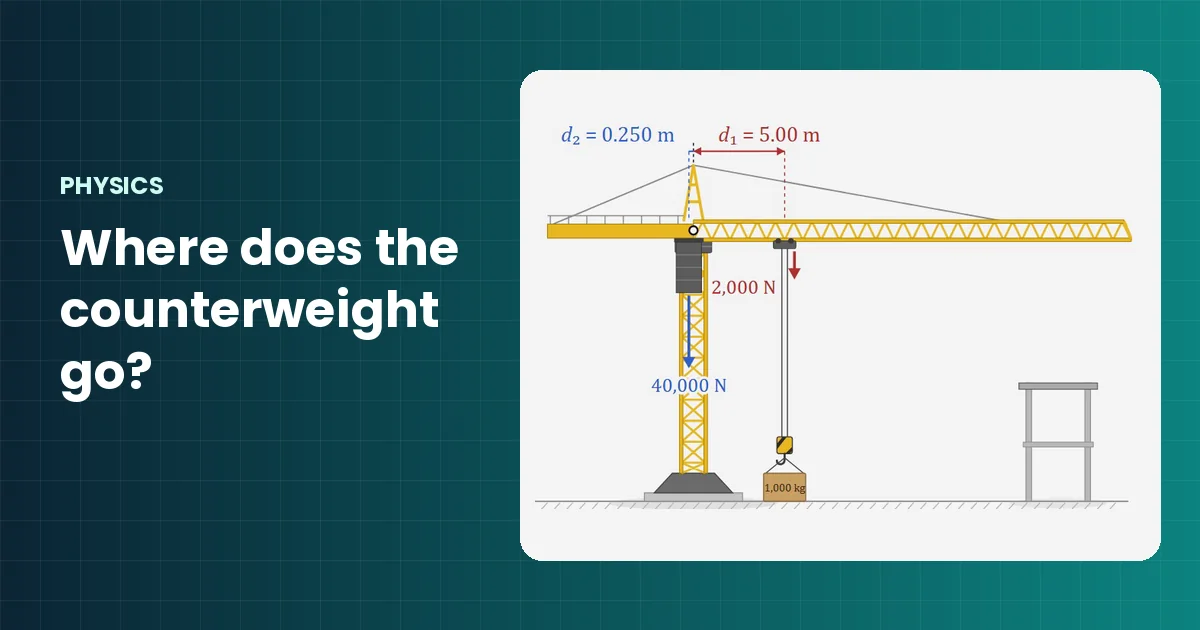
A tower crane lifts a crate far out on its jib, and yet it does not topple over. The reason is a simple principle from statics: every force that tries to rotate the crane is matched by another that rotates it the opposite way. If the load moves out, the counterweight has to do more work, and the question is how much more.
The idea in one sentence
A force turns a structure around a pivot with a strength called its moment, which equals the force times its distance from the pivot (M = F × d). The crane is balanced when the moment from the load equals the moment from the counterweight.
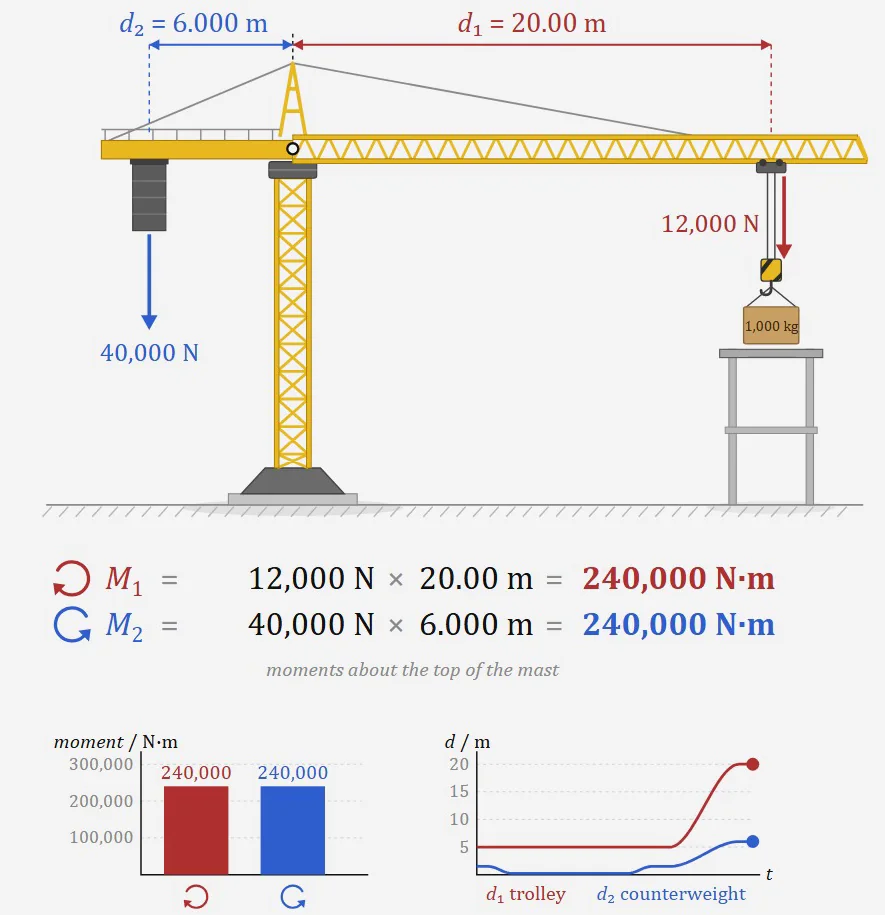
The diagram below shows the situation in a simplified model: the crane turns about the top of the mast, the load pulls one way, and the counterweight pulls the other way.
Step 1: Turn masses into forces
Moments use forces, so the first step is to convert mass into weight with weight = mass × g. With g = 10 N/kg, which is a convenient round number:
- Counterweight: 4,000 kg weighs 40,000 N
- Crate: 1,000 kg weighs 10,000 N
- Hook (block and hook): 200 kg weighs 2,000 N
Step 2: Find the force on the cable
The cable holds both the crate and the hook, so the force at the trolley is 10,000 N + 2,000 N = 12,000 N. If the crate rests on the ground or on a platform, the cable carries less, and with only the hook hanging it carries just 2,000 N.
Step 3: Balance the moments
With the crate hanging 20 m from the mast, the load moment is 12,000 N × 20 m = 240,000 N·m. The counterweight must produce the same moment: 40,000 N × d = 240,000 N·m, so d = 6 m.
The result also has a handy pattern. With the crate hanging, the counterweight distance is 0.3 times the load distance, because 12,000 N / 40,000 N = 0.3. If the load moves 15 m farther out, the counterweight would need to move 4.5 m farther out.
The common trap
Forgetting the hook gives 10,000 N × 20 m / 40,000 N = 5 m instead of 6 m. A 200 kg hook looks small next to a 1,000 kg crate, but it changes the answer by about 17%. In structural work, the weight of the lifting accessories counts.
What about a real crane?
The model slides the counterweight so you can see the balance at every instant. A real tower crane does not do that.
- The counterweight is fixed. Its mass and position on the counter-jib are set by the manufacturer for each jib length. For example, the SANY SYT315 carries 25,850 kg of counterweight with a 75 m jib and 8,600 kg with a 30 m jib.
- The structure carries the difference. An empty crane is slightly unbalanced by the counterweight, and the mast and the concrete base (or ballast) provide the stability. The foundation is designed for both working and out-of-service conditions.
- The load chart sets the limit. Close to the mast the limit is the cable and hoist; farther out it is the moment. The same SANY with a 75 m jib lifts 16 t up to 18 m but only 3 t at the tip, and the Potain MDT 189 lifts 8 t at most and 1.8 t at 60 m.
- A limiter protects the crane. The load moment limiter stops hoisting and trolley movement outward when load × distance passes the maximum.
Simplifications in the model
The calculation ignores the weight of the jib, counter-jib, mast, trolley and cables, which also create moments in a real crane. It assumes a vertical cable, no wind, no swinging and no acceleration, and it takes moments about the top of the mast rather than the edge of the base. It is a teaching model for the principle of moments, not a lifting-plan calculation.
Sources
- INSST: NTP 125, Grúa torre (tower crane safety systems, in Spanish)
- INSST: NTP 701, Grúas torre: recomendaciones de seguridad en su manipulación (in Spanish)
- SANY SYT315 (T7530-16) technical data sheet
- ScienceABC: How do tower cranes work
- Manitowoc Potain: top-slewing tower cranes
- Chiong Lab on Instagram: the original tower crane problem this model is based on