Articles › Process Engineering
How Does a Crude Oil Distillation Tower Work?
Published October 17, 2026
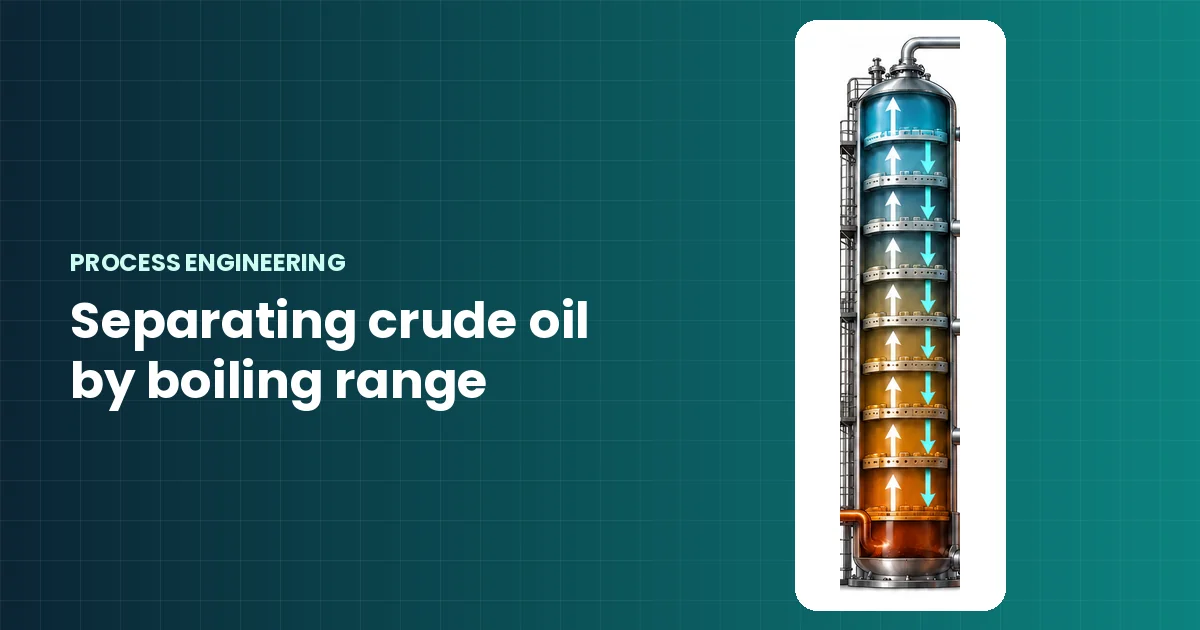
Crude oil is not one substance. It is a mixture of hydrocarbons with very different boiling ranges, and the first big job of a refinery is to sort that mixture into groups. The tool for that job is the atmospheric distillation tower, a tall column that separates crude oil into fractions without changing the molecules themselves.
The idea in one sentence
Different boiling ranges, different collection levels: lighter, more volatile components rise toward the cooler top of the column, while heavier, less volatile components stay toward the hotter bottom.
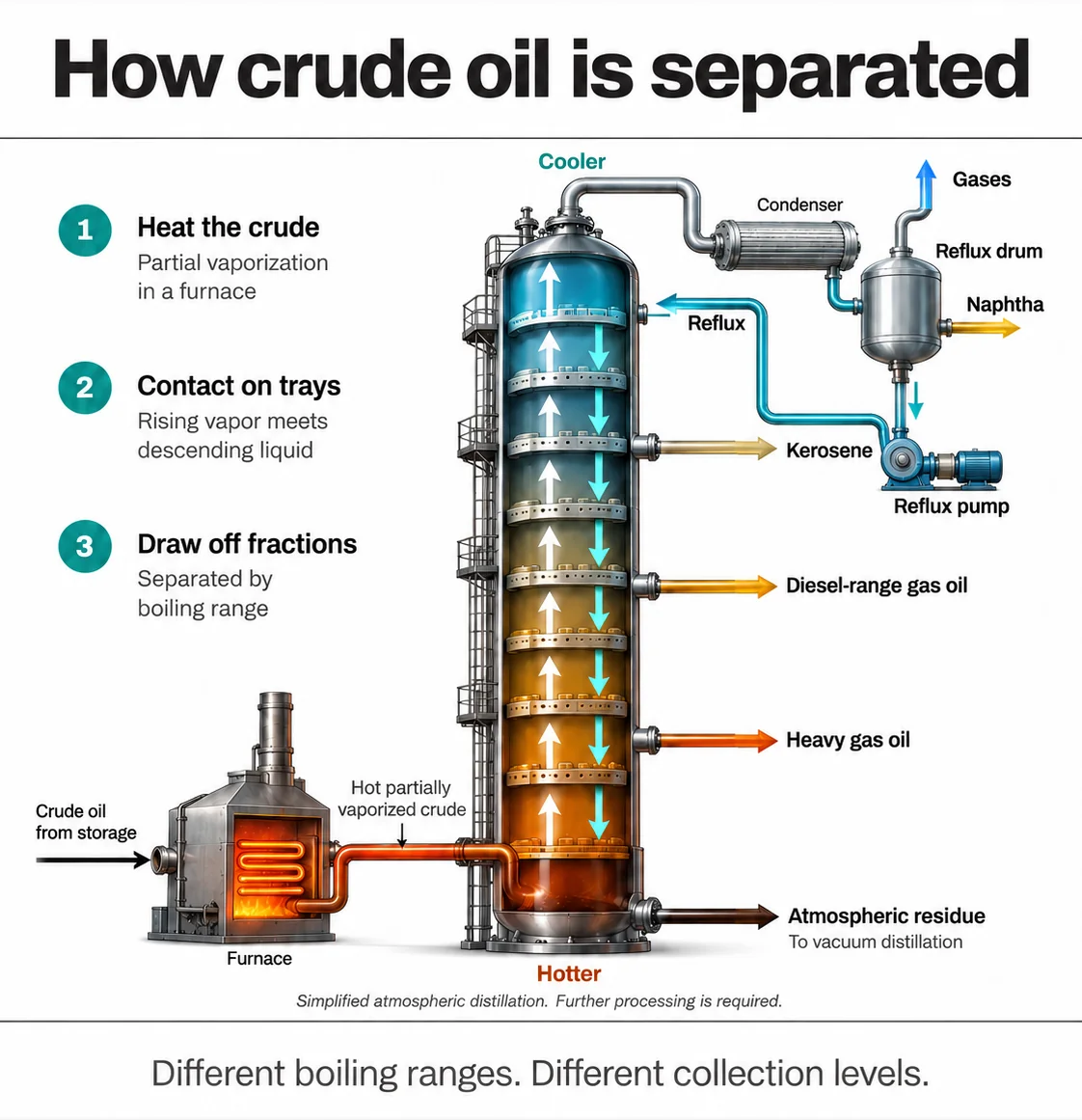
The diagram below summarizes the whole process: crude oil is heated in a furnace, vapor and liquid make contact on the trays, and fractions are drawn off at different heights.
Step 1: Heat
Before it enters the column, the crude oil is heated in a furnace. This vaporizes part of the mixture, so the stream that reaches the tower is a combination of hot vapor and liquid. The lightest components are the easiest to vaporize, and the heaviest ones largely stay liquid.
Step 2: Separate
Inside the tower, vapor rises while liquid flows down. The column contains trays (or packing) that force the two streams into repeated contact. At each stage, heavier components tend to condense and fall, while lighter components keep moving up. Repeated over many stages, this contact concentrates the more volatile components toward the top and the less volatile components toward the bottom.
At the top, the overhead vapor is condensed and collected in an accumulator. Part of that liquid is returned to the column as reflux, which helps keep the separation sharp, and the rest is withdrawn as a product.
Step 3: Collect
Because temperature falls as you move up the column, different fractions can be drawn off at different heights. Typical products, from the top of the tower to the bottom, include:
- Light gases and light naphtha from the overhead system
- Heavier naphtha
- Kerosene, the basis for jet fuel
- Gas oils, which are used to make diesel and heating oil
- Atmospheric residue from the bottom
The heavy residue is not waste. It can continue to a vacuum distillation unit, where lower pressure allows heavier material to be separated at lower temperatures, avoiding thermal breakdown.
Why distillation is only the first step
The fractions that leave the tower are not finished fuels. They usually need further processing, such as treating to remove impurities, converting heavier streams into lighter ones, or blending, before they become gasoline, diesel, jet fuel or petrochemical feedstocks.
Common misconceptions
- The tower does not separate by weight alone. The separation is based on boiling range, which is related to molecular size but is not the same thing as weight.
- Products do not come out of the tower ready to use. The tower produces intermediate streams that need more refining.
- The diagram is simplified. Real towers include pumparounds, side strippers, instrumentation and controls that are omitted here for clarity.
Sources
- U.S. Energy Information Administration: Refining crude oil, the refining process
- U.S. Energy Information Administration: Vacuum distillation is a key part of the petroleum refining process
- Sathyabama Institute of Science and Technology: Industrial Unit Operations course material (overhead condensation and reflux)